

SOLUTIONS
The Next Stage of Airline Ancillary Revenue: More Revenue, Less Complexity
Read the full article by CEO, Founder, Zsolt Kutasi here.
Airline ancillary revenue has evolved significantly over the past two decades. But the next major opportunity may not come from simply adding more ancillary products. It may come from fundamentally simplifying how airlines manage them.
Over the past few years, we have spent a great deal of time thinking about where airline ancillary revenue is heading — and, more importantly, what airlines actually need from ancillary management today.
Our group has been working in aviation for 21 years. For much of that time, we have generated significant ancillary revenue for airline partners through airport transfer services. In recent years, we have expanded our portfolio to include airport lounges, parking and other airport-related ancillary services.
As the number of products and airline partnerships grew, one challenge became increasingly clear:
One of the biggest barriers to ancillary revenue growth is often no longer the lack of the right product. It is the complexity involved in managing it.

The Hidden Complexity Behind Airline Ancillary Revenue
Through P-Labs, we launched a dedicated research and testing process to examine how small and medium-sized ancillary categories — excluding major verticals such as hotels and car rental — could be managed in a simpler, more efficient and more scalable way.
Consider what typically happens when an airline wants to introduce a new ancillary product or category.
The airline may need to research the market and compare available solutions, run a tender, negotiate with multiple suppliers, select and onboard partners, negotiate contracts, develop IT integrations, connect different technology systems, coordinate suppliers, manage administration and settlement, and address ongoing operational and customer service requirements.
For one ancillary product, that may be manageable.
But when an airline ancillary team is responsible for multiple categories — airport transfers, lounges, parking and other services — and potentially multiple suppliers within each category, the complexity multiplies quickly.
More suppliers mean more contracts, more integrations, more administration and, ultimately, more internal resources.
Yet the fundamental objective of an airline ancillary team is much simpler:
Generate more revenue, maintain high quality and deliver an excellent customer experience.
So we started asking a different question.
What If Airlines Didn't Have to Manage Every Ancillary Category Separately?
Through our work at P-Labs, we became increasingly focused on one challenge:
How can we remove ancillary complexity from the airline?
What if market research, supplier selection, commercial negotiation, product management, technology integration, operations and administration did not need to be managed as separate processes?
What if an airline did not need to create a separate technology integration and operating model every time it introduced a new ancillary category?
And what if the airline could manage both existing and new ancillary suppliers through a common model while retaining the flexibility to select the best solution for each category?
Those questions ultimately led us to create PlusAir ONE.
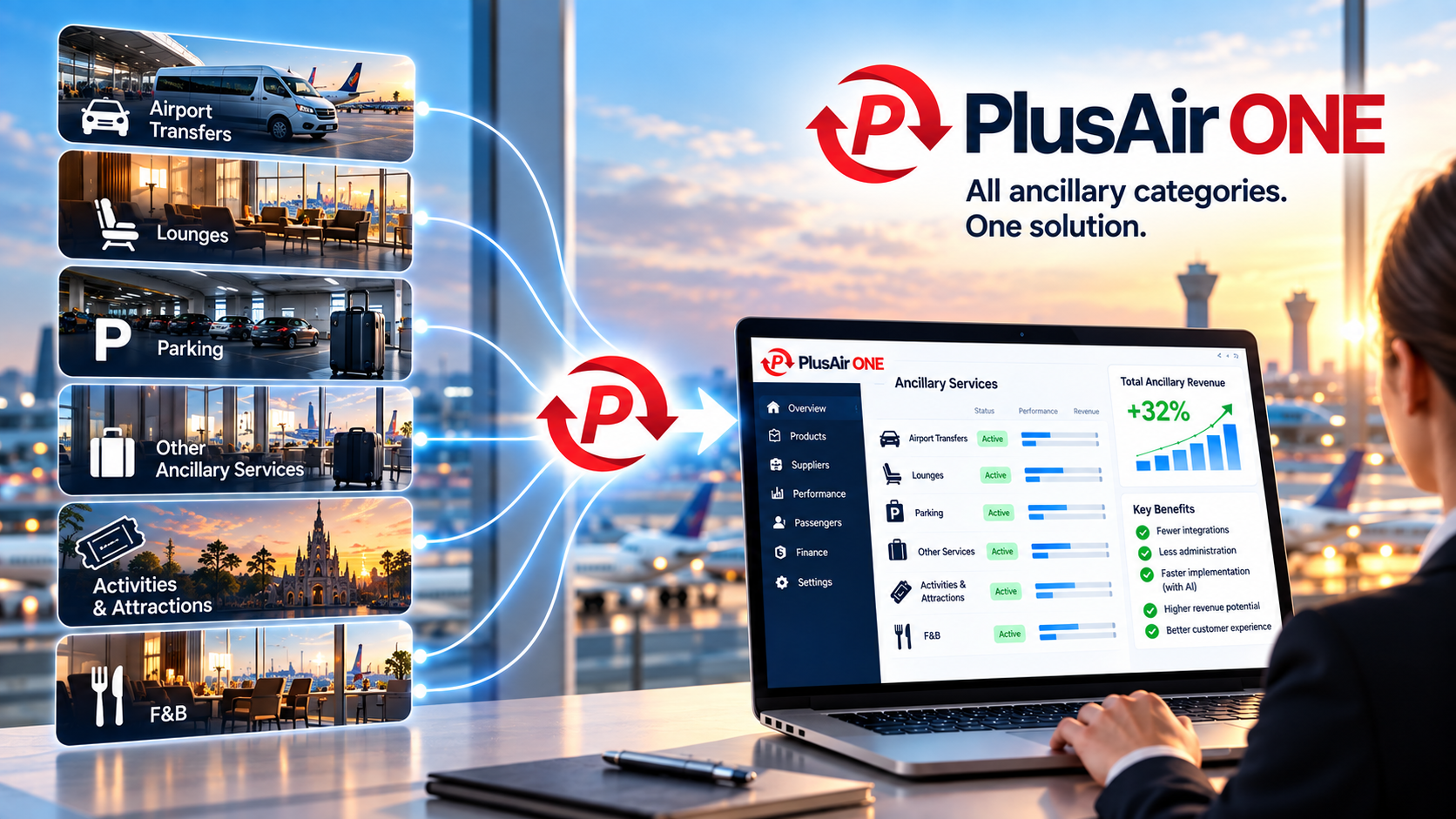
PlusAir ONE: A Different Model for Airline Ancillary Management
PlusAir ONE brings together technology, artificial intelligence and an expert team with more than two decades of airline ancillary experience to simplify the way ancillary services are managed.
Instead of treating each ancillary category as a separate technology, supplier and operational project, the objective is to create a common management layer between the airline and the wider ancillary ecosystem.
This can cover areas such as supplier management, commercial negotiations, product management, technology integration, operational coordination and administration.
Importantly, the model is not based on replacing suppliers for the sake of replacing them.
Our philosophy is straightforward:
There is no reason to replace an existing ancillary partner or service that performs well unless a change can deliver better quality, higher revenue or another measurable business benefit.
That means PlusAir ONE can integrate and manage an airline's existing ancillary services and suppliers within a common system.
At the same time, where the market offers a higher-quality, more competitive or higher-revenue-generating alternative, other solutions can be evaluated and a change made when there is a clear business case.
The objective is therefore not supplier replacement.
The objective is to enable the best possible commercial decision in every ancillary category while reducing the processes and internal resources required to manage them.
AI Can Change the Speed of Ancillary Implementation
There is another important development that makes this model particularly relevant today: artificial intelligence is changing how quickly airline ancillary solutions can be implemented and managed.
Historically, introducing a new ancillary service could involve lengthy technology projects, integration work and coordination between multiple internal and external teams.
AI-assisted development and automation can dramatically accelerate parts of this process.
With the right existing technology architecture, APIs, AI tools and experienced implementation team, certain PlusAir ONE integrations can potentially be completed in a matter of days rather than becoming lengthy development projects.
This is important not simply because implementation is faster.
It changes the economics of ancillary innovation.
If launching or testing a new ancillary category requires months of internal development, procurement and integration work, the potential revenue opportunity must be large enough to justify that investment.
But when technology and AI reduce the implementation burden, airlines can potentially test, launch and optimize smaller ancillary categories much more efficiently.
That opens the door to a more agile approach to airline ancillary revenue optimization.
From Static Supplier Management to Continuous Optimization
There is also a broader opportunity.
Traditional ancillary relationships can become relatively static. A supplier is selected, a contract is signed, an integration is built and the relationship may remain largely unchanged for years.
But the market does not stand still.
New suppliers emerge. Technology improves. Commercial terms change. Customer expectations evolve. New products become available.
A modern airline ancillary management platform should therefore do more than connect products.
It should help create an environment in which commercial opportunities can be continuously evaluated.
If the current solution remains the best option, keep it.
If a better opportunity emerges — whether through improved customer experience, stronger economics, better technology or higher revenue potential — evaluate it.
This creates a fundamentally different relationship between the airline and the ancillary market: one based on flexibility and continuous optimization rather than technological or contractual inertia.
The Future of Airline Ancillary Revenue May Be About Simplification
For me, perhaps the most interesting conclusion from our work at P-Labs has been this:
The next stage of ancillary development may not simply be about adding more products.
Airlines already have access to an enormous ecosystem of ancillary products and service providers.
The bigger opportunity may be making that ecosystem easier to access, manage and optimize.
That means enabling airlines to:
-
generate more ancillary revenue without proportionally increasing internal resources;
-
introduce and test new ancillary services faster;
-
reduce the number of separate integrations and operational processes;
-
manage existing and new suppliers within a more unified model;
-
continuously evaluate commercial opportunities; and
-
retain the flexibility to select the best solution for each ancillary category.
This is the thinking behind PlusAir ONE.
The future of airline ancillary revenue management may ultimately be less about how many products an airline can add and more about how intelligently, efficiently and flexibly those products can be managed.
More revenue. Less complexity.
PlusAir ONE is an airline ancillary management model combining technology, AI and more than two decades of aviation and ancillary experience. It is designed to help airlines simplify the management of airport-related and other ancillary services, integrate existing suppliers, evaluate new revenue opportunities and reduce the internal resources required to manage multiple ancillary categories.
Key topics: Airline ancillary revenue, ancillary revenue management, airline ancillary services, airline retailing, airline ancillary technology, AI in aviation, airline revenue optimization, airport ancillary services, airline efficiency, ancillary management platform, aviation technology, airport transfers, airport lounges, airport parking, PlusAir ONE.